
El Paso County Parole and Probation
A released El Paso County person may be on probation, parole, pretrial release, community corrections, or no supervision. Those terms are not interchangeable. Probation is normally ordered in the criminal case and supervised through Colorado Judicial Branch probation services. Parole follows a Colorado Department of Corrections prison sentence, with release decisions handled by the Colorado State Board of Parole and field supervision handled through CDOC Adult Parole.
The county jail roster is not a post-release supervision lookup. A person can disappear from the El Paso County Jail search because they bonded out, went to CDOC, started probation, transferred to another agency, or completed a local sentence. The right confirmation source is the one that has legal control after release.
| Path | Who orders or controls it | Best verification source |
|---|---|---|
| Probation | Sentencing court and probation services. | El Paso County court docket and probation record. |
| Parole | CDOC and Colorado State Board of Parole. | CDOC offender search, parole board source, Adult Parole. |
| Pretrial release | Court order before final disposition. | Court docket, bond order, and sheriff booking detail. |
| Community corrections | Court, CDOC, or local community-corrections structure. | Sentencing case, CDOC, and community-corrections records where public. |
Verify El Paso County Supervision
Verification starts by classifying the sentence. If the person left the El Paso County Jail after a county case and no prison sentence followed, the court record is usually the main source. If a CDOC sentence followed, use CDOC and parole sources. For a full release record, match supervision status to the release path on the El Paso County released inmates hub.
- Find the sheriff booking detail if it is still visible, then note the court case number, bond fields, holds, warrants, and release date fields.
- Check the El Paso County court docket for the disposition, sentence, probation order, revocation filing, or mittimus to CDOC.
- Search CDOC Offender Search by DOCNO, last name, first name, and gender when a prison sentence or parole is possible.
- Use the Colorado State Board of Parole and CDOC parole materials for parole hearings, decisions, and supervision context.
- Use the supervising agency or court clerk for formal proof, since online records may lag or omit non-public details.
Do not infer parole, probation, or absconder status from a missing jail search result. Use CDOC, court, parole, and warrant sources.
El Paso County Parole Hearings
The CDOC offender-search application includes a Parole Board calendar tab. During research, the calendar displayed rolling monthly views and instructed users to hover over dates for schedules and click a calendar title for a larger view. Treat the calendar as live because dates and hearing events can change.
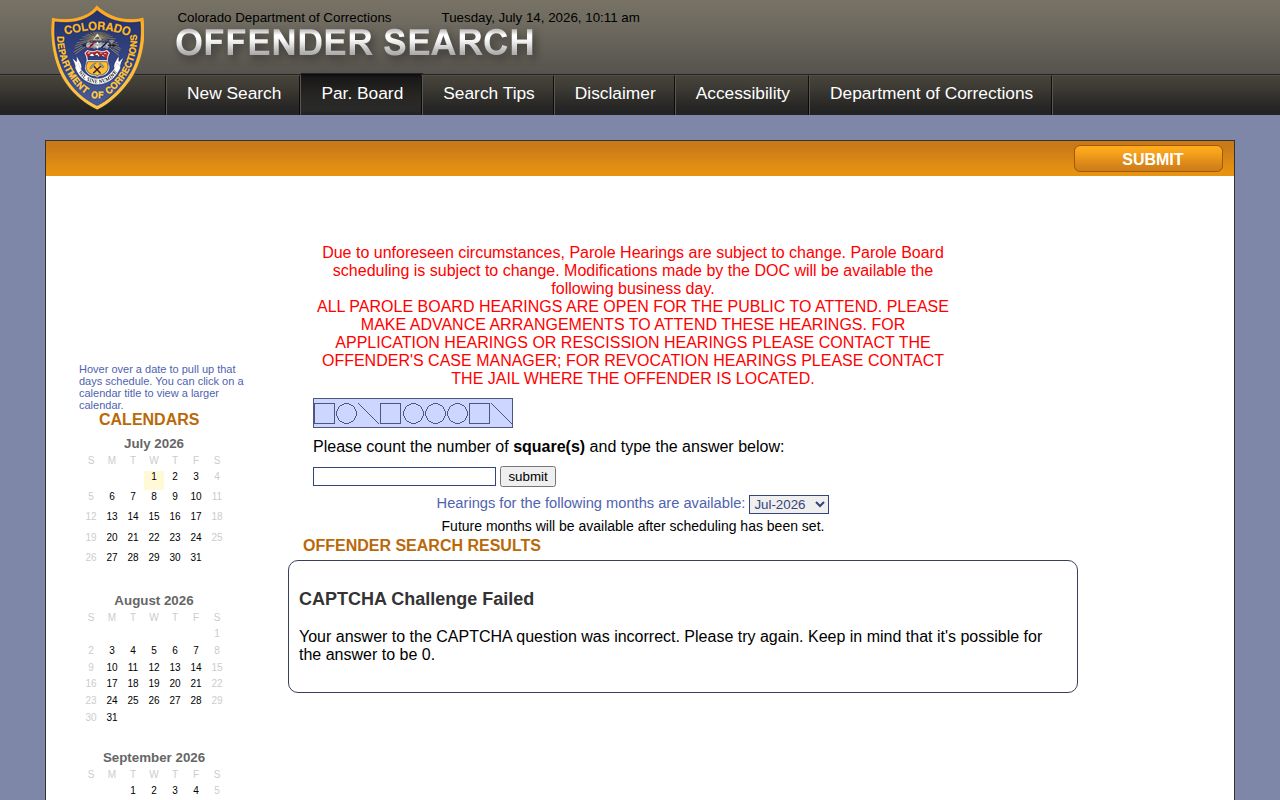
A parole-board action does not always mean same-day physical release. Release can depend on the approved plan, detainers, warrants, administrative processing, or a later CDOC status update.
El Paso County Supervision Sources
Use the source that matches the form of supervision. CDOC handles state parole and re-entry services. The Colorado Judicial Branch is the court and probation path for El Paso County cases. VINELink can help with custody-change alerts, but it does not replace the court sentence or official supervision record.
Colorado Department of Corrections
Offender Search: doc.state.co.us/oss
Adult Parole and Re-entry: cdoc.colorado.gov/parole-and-re-entry-services
El Paso County Trial Courts
Colorado Judicial Branch local court page: El Paso County trial courts
Use for criminal disposition, probation orders, warrant action, and sentence records.
El Paso County Warrants and Holds
The sheriff booking detail has separate holds and warrants tables. That local detail matters for parole and probation questions. A release date on one charge row does not prove that the person was free to leave if another warrant, hold, or detainer remained active. It also does not prove that the person absconded from supervision.
For a parole absconder, use CDOC or parole sources. For a probation warrant, use the court record. If the person is booked again in El Paso County, the sheriff search may show warrant information in the booking detail. Any release or warrant status should be checked against the source that issued it.
Note: A detainer is a hold or request from another agency that can delay release after a local jail matter changes status.
El Paso County Reentry Records
El Paso County has local community-corrections and reentry context, including former or historical facilities such as Cheyenne Mountain Re-Entry Center. These records can confuse a release search because community corrections, parole, and jail release are separate systems. A person may leave the county jail for CDOC, parole, or a community placement instead of ending all supervision.
The safest path is to connect the sentencing case to the supervising agency. Use CDOC for state-prison and parole status, the court for probation and community-corrections orders, and county jail records only for the jail custody event. Older facility names are clues, not proof of current custody.
El Paso County Property and Errors
El Paso County's inmate-services materials describe a property-release process: the inmate must complete and approve a property release form, and the person receiving property must present valid picture identification. That process can help families after release or transfer, but it is not a supervision record and does not prove parole or probation status.
If a record appears wrong, start with the agency that published it. Contact the sheriff or booking desk for jail records, CDOC for offender or parole records, and the court clerk for docket or sentencing errors. Bring the court order, case number, DOC number, or booking number that supports the correction request.
El Paso County Supervision Terms
Short definitions help keep post-release records straight. The same person may pass through more than one category, so the record should identify both the custody event and the supervision status.
- Parole
- Community supervision after a Colorado prison sentence.
- Probation
- A court sentence supervised through probation, often instead of prison.
- Discharge
- The end of a sentence or supervision term under the responsible agency.
- Absconder
- A supervision status that should be confirmed through official parole, probation, or court sources.
- Revocation
- A court or parole-board action that can return a person to custody after a violation process.
El Paso County Supervision Discharge
Supervision ends through the agency that controls it. Probation can terminate through the court or probation record. Parole discharge is a CDOC or parole record. A jail release date does not show that supervision ended, and a supervision discharge does not rewrite the original jail booking by itself.
Colorado sentence and parole calculations depend on sentence type, offense date, credits, parole eligibility, and board decisions. Title 17, Article 22.5 of the Colorado Revised Statutes contains key parole eligibility and earned-time provisions. Use CDOC or the court for formal release and discharge proof when dates matter.
El Paso Supervision Notifications
VINELink is useful when the practical question is whether a person is still in custody or whether a custody status has changed. It is not a full parole or probation case file. Search Colorado in VINELink by name or ID, open the person-specific record, and register for available phone, email, text, or app alerts. If VINELink sends a release or custody-change notice, reconcile it with the court docket, sheriff record, or CDOC profile.
Registrant searches are different. The Colorado sex-offender registry can show certain released registrants because registration obligations can continue after jail or prison custody. It is not a general released-inmate or supervision lookup. Registry presence does not explain the jail release date by itself, and registry absence does not prove that a person was never released or never supervised.
El Paso Parole Decisions
Parole-board decisions should be read with the CDOC profile and court sentence. A board action may grant, deny, defer, continue, rescind, revoke, or otherwise change the release path, but the official source controls the label for a specific event. A parole grant may still require release-plan approval, administrative processing, or resolution of detainers before physical release happens.
For El Paso County cases that became CDOC sentences, the county jail record explains the earlier local custody event. The parole-board record explains the state release decision. Adult Parole explains community supervision after prison. Keeping those records separate prevents a jail release date from being mistaken for a parole discharge date.
El Paso Probation Court Records
Probation verification usually starts with the court docket because probation is a sentence ordered by the court. The docket can show the probation term, conditions at a high level, review dates, revocation filings, warrant activity, modification orders, or termination. Public online access may not show every supervision detail, so formal proof may require the clerk, probation office, or counsel depending on the record.
A person released from the jail to probation may no longer appear in the sheriff search even while the criminal case remains active. That is normal. Use the court case number from the booking detail to connect the jail release to the probation sentence.
If the docket shows a later revocation, modification, or termination, read that later entry with the original sentence. A supervision record can change after the jail release date, so the most recent court or CDOC entry controls the current status.